
Free AI Detector and Writing Tools for Academic Work
An AI detector trained on academic prose, a citation generator for the six styles universities ask for, readability and vocabulary checkers, image-to-text OCR, document conversion and an open-access paper finder. Free, in the browser, and none of it needs an account.
Used by students and researchers at universities worldwide
















Everything you need to write better
One flagship tool, backed by a focused set of everyday utilities.
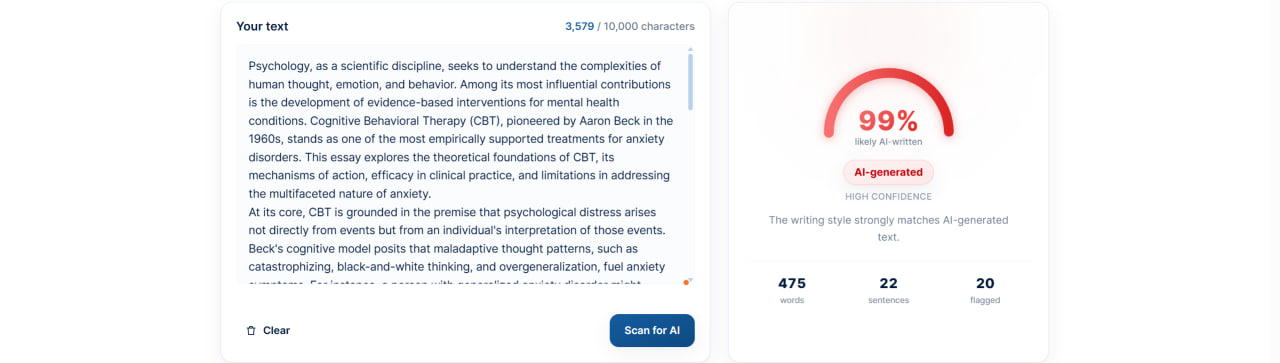
Tools that check, tidy, format and find
None of them will write your work for you - there is no essay generator here and there is not going to be one. They handle the parts of academic writing that are mechanical rather than intellectual, and they tell you plainly what they cannot do.
PT Academia is the writing-tools division of PT Technologies.
Why PT Academia
Tools that stay out of your way and just get the job done.
Fast and simple
Clean, focused tools that do the job without clutter or sign-up friction.
Honest about what they do
A score comes with its reasons and its error rate. No promises we cannot keep.
Built for academic work
Essays, theses, papers and reports - the writing you have to hand in.
Private by design
Several tools run entirely in your browser. Where one needs our server, the policy says what is kept.
What this site is for
PT Academia is a set of tools for writing you have to hand in - an essay, a dissertation chapter, a report, a paper. Not marketing copy, not blog filler. That focus is why the tools look the way they do: the AI Detector is trained on academic prose rather than web text, the Citation Generator covers the six styles universities actually ask for, and the Paper Finder only returns copies that are legally free to read.
All of it is free and open with no account. Signing in adds one thing: your detector scans are saved so you can look back at them. It is the writing-tools division of PT Technologies, a software company registered in Tashkent, which also builds apps and business software under its other divisions.
What none of these tools will do is write your work for you. There is no essay generator here and there is not going to be one. The tools are for checking, tidying, formatting and finding - the parts of academic writing that are mechanical rather than intellectual.
Where to start, depending on what you have
If you want to know how your writing reads to a detector before someone else runs it, the AI Detector gives you a score, the sentences behind it, and the measurements behind each sentence. If it comes back higher than you expected, the honest reasons are usually structural rather than sinister - see the section below.
If your prose feels flat and you cannot say why, the Lexical Diversity checker measures vocabulary variety and points at the specific culprits: the verb you have used eleven times, the four paragraphs that all open with "However", the run of sentences that are all the same length. The Readability Checker puts six formulas side by side and shows what each one is actually measuring.
If you are assembling sources, the Citation Generator turns a DOI, ISBN, URL or title into a formatted reference in APA, MLA, Chicago, Harvard, IEEE or Vancouver, and the Paper Finder locates a legal free PDF of a paper when one exists. The Word Counter, Speech Calculator, Title Case Converter, Image to Text and PDF converter handle the mechanical jobs around a deadline.
Where we stand on AI detection
We build an AI detector, and we will tell you plainly that no AI detector is accurate enough to decide anything on its own. Ours prints that on every page of every report it produces.
The reason is arithmetic rather than modesty. A detector measures statistical properties of the words on a page - how predictable they are, how much the rhythm varies - and converts them into a probability. Those properties differ on average between human and machine prose, and "on average" is doing a great deal of work. Writing in a second language, following the essay structure you were taught, working in a formulaic genre like a methods section, or editing a draft heavily all push a score up without anything being wrong.
So we publish our error rates instead of claiming certainty, report when a score is unstable or when a text sits outside what the model was calibrated on, show which sentences drove the number, and set a higher bar on short text where the evidence is thinnest. A score is a signal worth looking at. It is not proof, and it should never be the only basis for a decision about a person.
What is free, and what a subscription buys
Free, with no account: the AI Detector at up to 10,000 characters a scan, the Citation Generator, Title Case Converter, Lexical Diversity checker, Readability Checker, Word Counter, Speech Calculator, Image to Text, PDF and Word conversion, and the Paper Finder. Free with an account: your detector scans saved so you can look back at them.
Standard is $3.99 a month and raises the ceilings rather than unlocking a different product: AI Detector scans up to 100,000 characters, and batch scanning for up to 40 documents at once with CSV export.
Several of the tools run entirely in your browser - the word counter, the lexical checker, image-to-text and the document converter - which means the text never reaches us at all. Where a tool does need our server, the privacy policy says exactly what is kept and for how long.
Common questions
Do I need an account?
No. The AI Detector, Citation Generator, Title Case Converter, Lexical Diversity checker, Readability Checker, Word Counter, Speech Calculator, Image to Text, PDF/Word converter and Paper Finder are all open to everyone. A free account only adds saved detector scans, and the Standard plan sits on top of that.
Is it actually free, or is this a trial?
Actually free. There is no time-limited trial and no card required. Standard at $3.99 a month raises the detector limits and adds batch scanning, but the free tier is a permanent tier, not a countdown.
Is my text stored or used for training?
No text is used for training anything. Several tools never send your text anywhere, because they run in your browser. Where text does reach our server it is processed to produce the result you asked for and not retained, apart from a short snippet in your AI Detector scan records when you are signed in - described in the privacy policy and deletable.
Can I use the AI Detector to prove a student used AI?
No, and please do not try. A percentage is evidence at best, it is least reliable exactly where the stakes are highest - short work, non-native writers, heavily edited drafts - and treating it as proof is how people get wrongly accused. Use it as one input alongside drafts, version history and a conversation.
Which citation styles are supported?
APA, MLA 9, Chicago (both notes-and-bibliography and author-date), Harvard, IEEE and Vancouver. References are built from publisher records via DOI, ISBN, URL or title, and the bibliography stays in your browser between visits.
What happened to the AI Humanizer?
It was shut down permanently on 22 September 2026. Its page stays up so that old links say so rather than returning an error, but the tool will not return.
Does it work on a phone?
Yes. Every tool is built to work at phone width, including file uploads and the PDF reports. The one exception is batch scanning, which is designed around a desktop file picker and a results table.